Around University Park · walk 7 of 8 ·
Victorian houses of St. James Park and Chester Place
North of the university, a few blocks of late nineteenth-century houses survive from the years when this was one of the city's wealthiest neighbourhoods.
- Metro23rd St, E Line
- Getting thereE Line or bus to Adams Boulevard
- BringComfortable shoes, water, a respectful pace
In the 1880s and 1890s, as Los Angeles grew from a small town into a city, its richest families began building large houses on the open land southwest of downtown. The streets around Adams Boulevard and Figueroa Street became the smart address of the age, lined with Queen Anne, Shingle Style and Mission Revival houses. Most of that world has gone, but a few pockets remain just north of the USC campus, and two of them, Chester Place and St. James Park, make a rewarding walk.
This is a residential and institutional area. Many of the houses are private homes, offices or university buildings, so this is a walk for the street, the pavement and the view over the fence, not for knocking on doors.
A neighbourhood of the 1890s
Before the motor car, the area west of Figueroa was reached by streetcar, and it offered space, gardens and distance from the noise of downtown. Oil, railway and banking fortunes paid for large houses here, many designed by the leading local architects of the day. Through the twentieth century the wealthy moved further west, the big houses were divided up or replaced, and much of the old character was lost.
What remains is protected in part by historic district status. The North University Park area, north of the campus, includes a number of surviving late nineteenth- and early twentieth-century houses along its streets, and several are listed as city historic monuments.
Chester Place and the Doheny Mansion
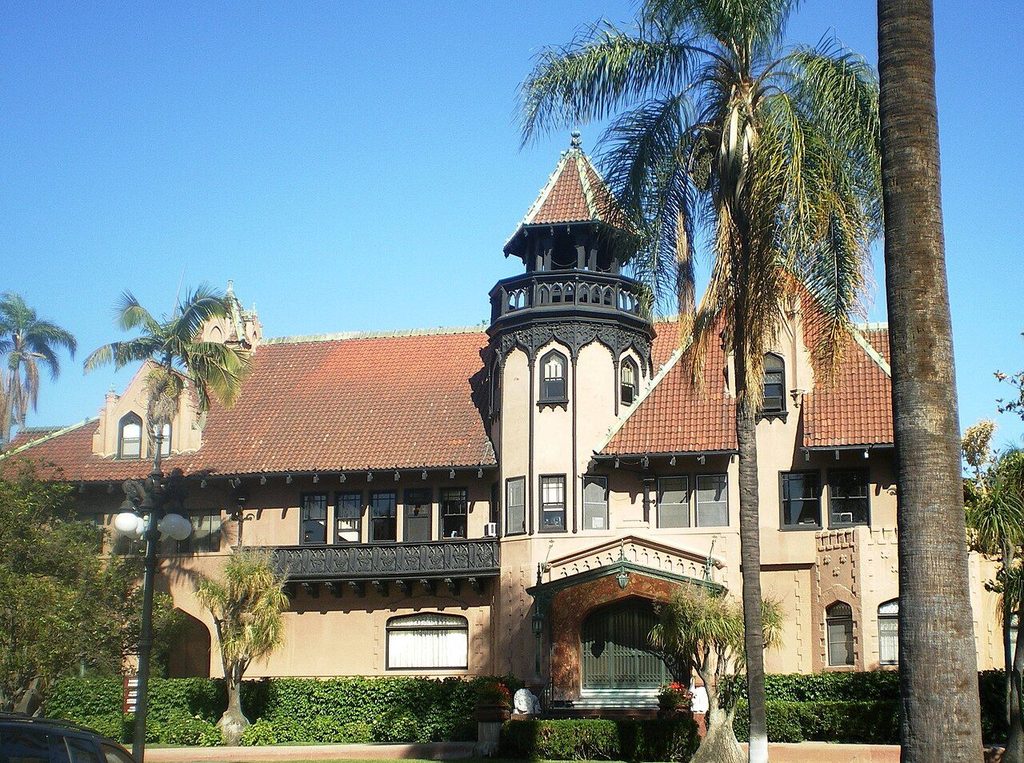
Chester Place is a private, gated street of large houses laid out in the late nineteenth century. Its most famous house is the Doheny Mansion, built at the turn of the twentieth century and bought soon afterwards by the oil businessman Edward L. Doheny, who lived there for decades. The house mixes Gothic and Spanish details in a style all its own, with a tall corner tower capped by a pointed roof, dark carved balconies, a red tile roof and an arched front door set in a decorated stone frame.
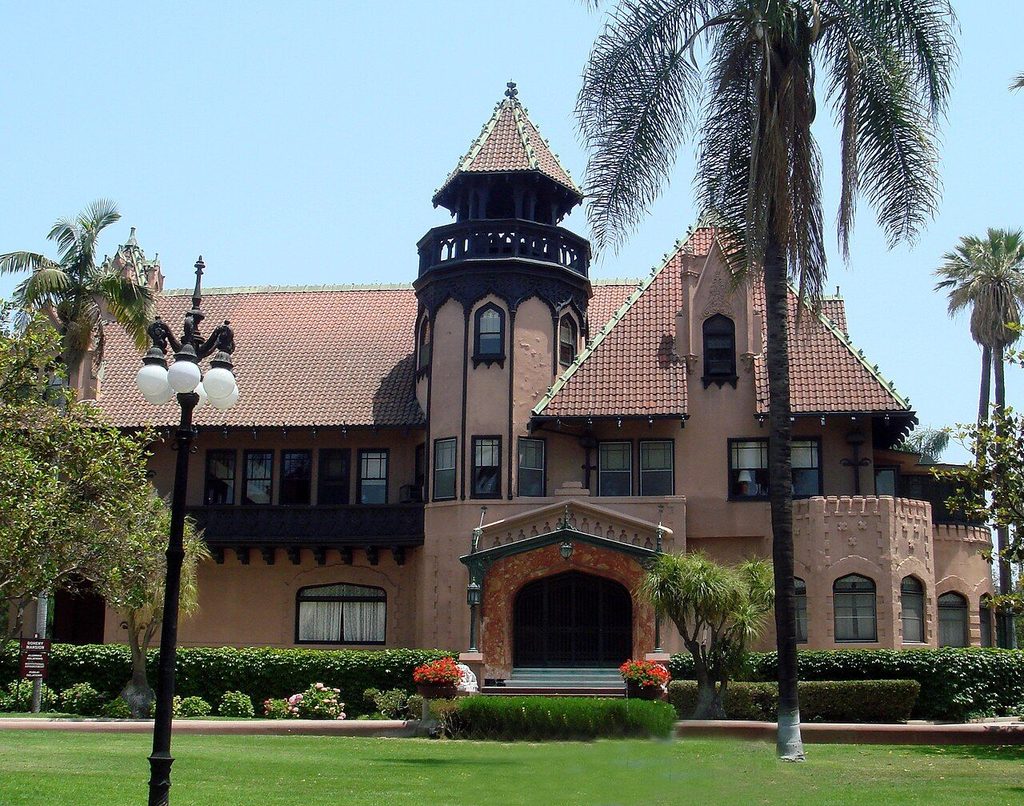
Chester Place later passed to a Catholic religious order and is now part of a university campus, which uses the houses for teaching, offices and residence. The street is not generally open to the public, though the mansion has at times been open for tours or concerts. Most days, what you see is what shows from outside the gates.
Next door: Brick and arches on the USC campus
St. James Park
A short walk away, St. James Park is a small patch of green surrounded by a handful of grand houses, laid out in the late nineteenth century as a private residential park. The houses facing it are a mix of styles from the same era, with deep porches, turrets, gables and tall chimneys. Some are now used as offices or for the nearby university; others are homes.
The houses were built at a time when Los Angeles architects freely borrowed from many sources, so a single block can mix a round tower from one tradition with a porch from another and a roof from a third. That variety is what makes the area enjoyable to read. Notice how the builders used wood, stone and brick, and how each house sits on its lot with a lawn in front.
The park itself is quiet, and it gives a rare sense of how the neighbourhood looked when it was new: a small green with large houses set back behind lawns and old trees. Walk slowly around its edge, and look at the details: the shaped shingles, the window glass, the porch columns.
North University Park houses
Beyond Chester Place and St. James Park, the streets of North University Park hold more survivors from the decades around 1900. Some are built of wood, with turrets and wraparound porches; others, like the stone-faced house in the photograph below, show a heavier style, with rough masonry, a round corner bay and a deep front porch.
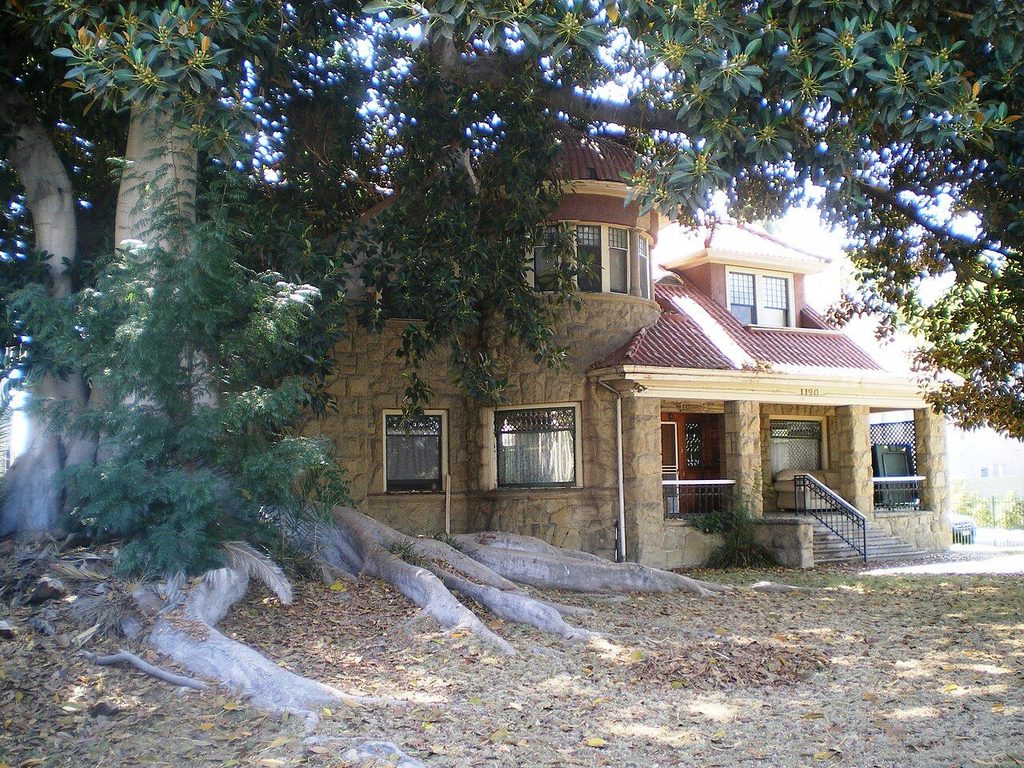
Many of these houses are listed as city monuments or as contributors to the historic district. They are lived in, and some have been carefully restored by their owners. Enjoy them from the pavement, and do not climb fences, block driveways or photograph people at their windows.
A respectful walk
A loop of about an hour takes in the main sights. Start near Adams Boulevard and Figueroa Street, walk west past the gates of Chester Place, then on to St. James Park, and back through the streets of North University Park towards the campus.
- Keep to public pavements and parks; most houses and the gated street are private.
- Be quiet in the early morning and evening.
- Photograph architecture, not residents, and keep your camera off people's homes when they are outside.
- Do not park across driveways or on narrow side streets.
The neighbourhood sits beside the university, and our story on brick and arches on the USC campus continues the walk south through the Romanesque halls. From there, Exposition Park and its Natural History Museum are just across Exposition Boulevard.
From 23rd St station
The closest stop on the E Line is 23rd St station, a short walk east of the area. Buses along Figueroa Street and Adams Boulevard also stop nearby. Expo Park/USC station, to the south, works as well if you plan to walk the full loop through campus. Parking on the residential streets is limited and often permit-controlled, which makes the train the easier way in.
Filed in Around University Park
Walk on: The E Line from Exposition Park to the sea · back to University Park · all eight walks
Thanks for the photos: Los Angeles; license CC BY-SA; Bobak Ha'Eri; license CC BY; Los Angeles; license CC BY


