Inside Exposition Park · walk 2 of 8 ·
The Natural History Museum and its gardens
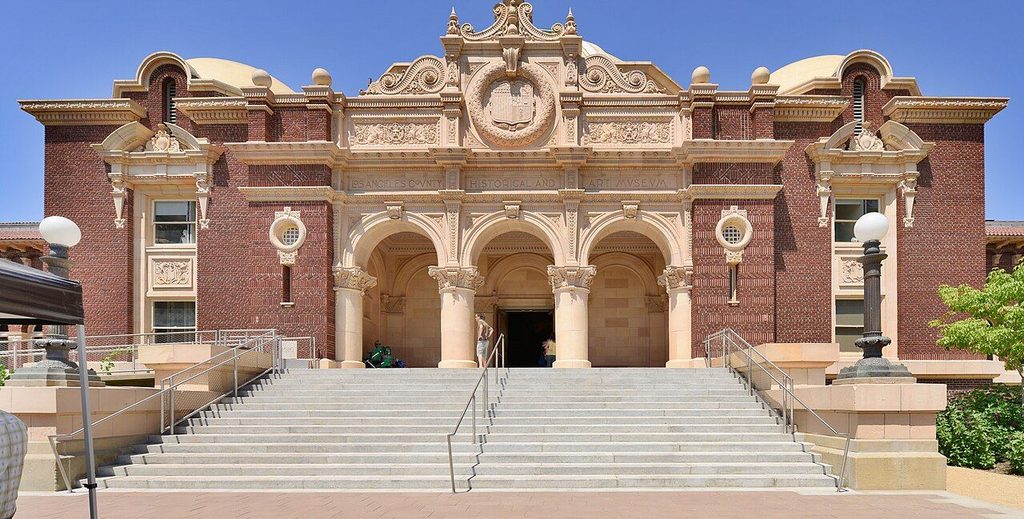
A brick and terracotta building from 1913, a hall of dinosaur skeletons, old habitat dioramas and outdoor gardens that bring the city's wildlife right up to the museum walls.
- MetroExpo Park/USC, E Line
- Getting thereE Line to Expo Park/USC, short walk
- BringComfortable shoes, a light layer, water for the gardens
The Natural History Museum of Los Angeles County is the oldest of the museums in Exposition Park and the one with the most varied collection. Inside one building you find dinosaur skeletons, gems and minerals, dioramas of animals in their habitats, and long galleries on the history of Los Angeles itself. Outside, the museum has turned part of its grounds into gardens planted for insects, birds and lizards. A full visit takes most of a day; a focused one, picking two or three halls, fits into a morning.
This guide follows the building from its oldest part outwards: the 1913 front and its rotunda, the dinosaur hall, the dioramas and other galleries, and finally the gardens, which you can walk through even if you decide not to go inside.
A 1913 building in brick and terracotta
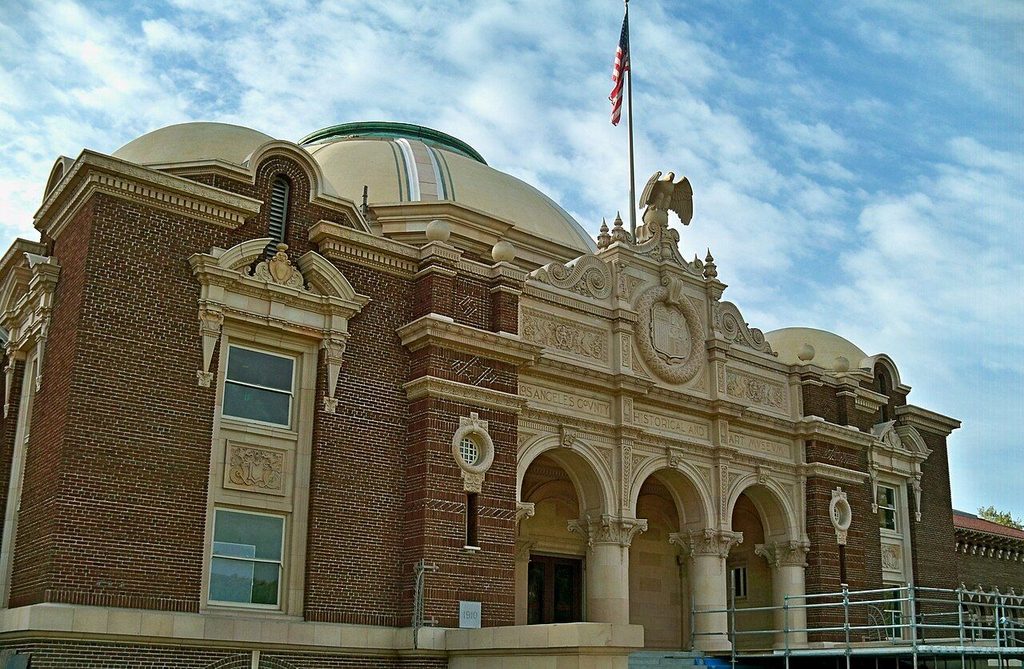
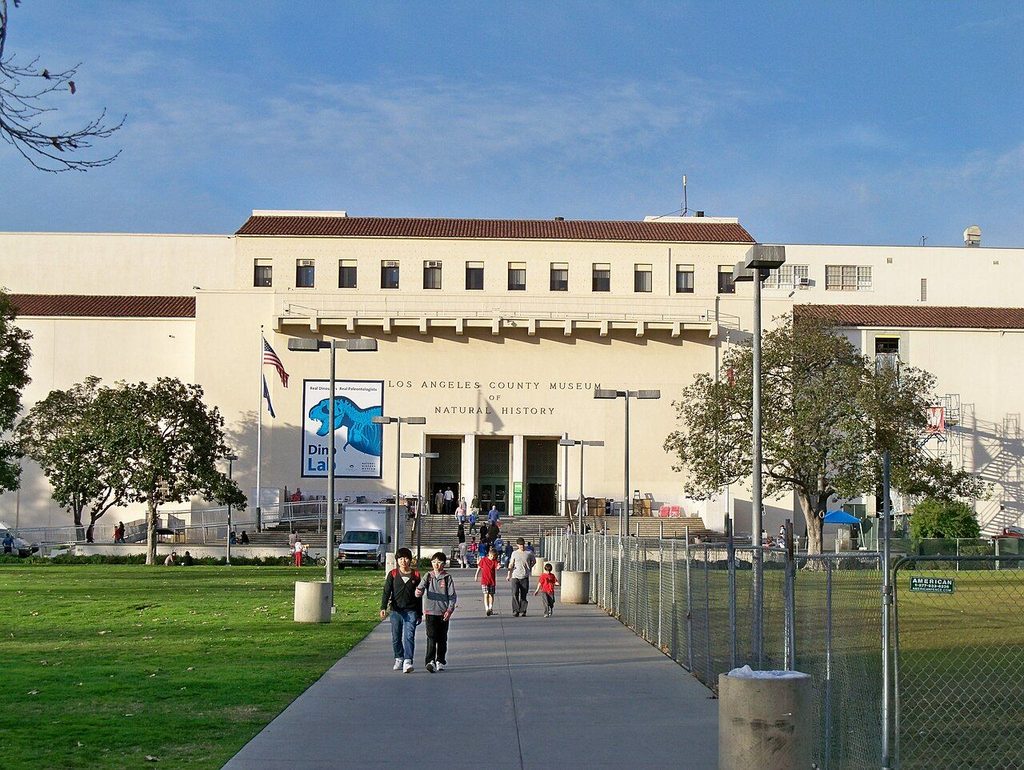
The museum opened in 1913 as the Museum of History, Science and Art, and the original building still faces the park. It is a Beaux-Arts design in red brick with pale terracotta trim, a row of round arches over the entrance, and a large central dome flanked by smaller ones. Look up at the facade and you can still read the old names carved into the stone above the arches, from the years when the museum covered art as well as science.
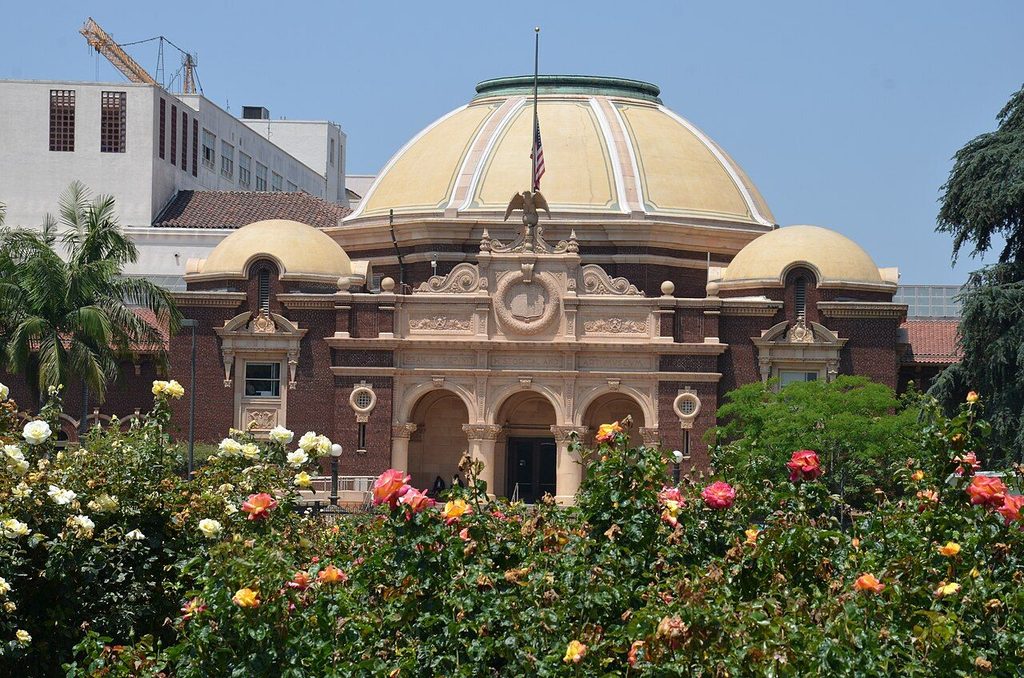
The front looks south over the sunken rose garden, and the two were planned to be seen together. From the garden steps the domes line up with the central path, which is the classic view of the building; our story on the sunken rose garden covers that side of the scene. Later wings were added to the north and west through the twentieth century, and the museum's present main entrance is on the north side, facing the gardens and the parking areas, rather than through the old arches.
The rotunda
Inside the old building, the rotunda is the room to find first. It rises under the main dome, with marble walls and columns, a stained-glass skylight at the top, and a bronze sculpture at its centre of three female figures representing history, science and art. The room has been restored and is often used for events, so parts may be closed at times, but in normal opening hours you can usually walk through it and stand under the dome.
The rotunda is also a good orientation point. The galleries in the 1913 wing open off it, and from here signs lead you to the dinosaur hall and the newer parts of the building. If the museum is busy, it is one of the few quiet rooms in the place, because most visitors head straight for the dinosaurs.
The dinosaur hall and the T. rex growth series
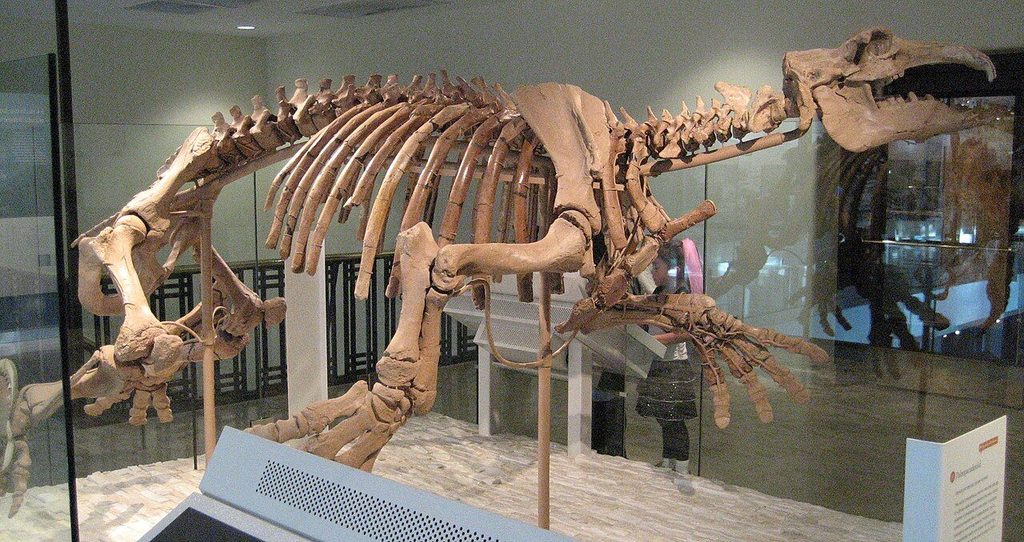
The dinosaur hall is the museum's best-known gallery. It holds a large number of real fossil skeletons and casts, mounted in active poses across two levels, with walkways that let you see some of the big animals from above as well as from the floor. The display works hard to explain how scientists know what they know, with fossil bones, tracks and plant remains alongside the full mounts.
The centrepiece is a series of Tyrannosaurus rex skeletons of different ages, from a young animal to a much larger subadult. Seen together they show how the species changed as it grew, from a long-legged, lighter juvenile to the heavy-headed adult form most people picture. It is one of the clearest lessons in the building, and it is worth reading the labels rather than just taking photographs.
Seen together they show how the species changed as it grew, from a long-legged, lighter juvenile to the heavy-headed adult form most people picture.
The hall also covers marine reptiles and other animals that lived alongside the dinosaurs. Nearby galleries carry the story forward into the age of mammals, with skeletons of extinct animals that once lived in and around what is now California.
Next door: Space Shuttle Endeavour and the Science Center
Dioramas, gems and the story of Los Angeles
Some of the museum's most memorable rooms are its oldest-style ones. The halls of African and North American mammals are lined with glass-fronted habitat dioramas, each a group of mounted animals in front of a painted background that blends into a built foreground of rocks, grass and snow. They were made in the middle decades of the twentieth century, and the painting and modelling are still remarkable close up. The rooms are dim and quiet, and they reward slow walking.
The gem and mineral hall is the other classic gallery, with cases of crystals, cut stones and a vault of precious specimens. Elsewhere, galleries on the history of Los Angeles follow the region from its first peoples through the Spanish and Mexican periods to the growth of the twentieth-century city. A glass pavilion near the north entrance holds a long whale skeleton hanging overhead, one of the first things many visitors see.
- Pick two or three halls rather than trying to see everything in one go.
- Visit the dinosaur hall early or late in the day, when school groups are fewer.
- Leave time for the gardens, which are easy to miss if you leave by the front.
The Nature Gardens
On the north side of the museum, the Nature Gardens cover a few acres of what was once lawn and parking. They were planted to attract and study the wild animals that live in the city, and they work: you can expect to see hummingbirds, butterflies, bees and lizards on a sunny day, and there are signs and small exhibits explaining what lives where. A pond, a vegetable and herb garden, a dry slope of native plants and shaded paths make up the main parts.
The gardens connect to the museum's nature lab inside, which looks at urban wildlife and the work of community scientists who record what they find. Even a short walk here changes how you see the rest of Exposition Park, and the city beyond it. Later in the day, the low light across the planting makes this the best place for a quiet sit before you leave.
Tickets, hours and practical notes
The museum charges for general admission, with discounts for some groups and free hours or days that have at times been offered to county residents, students and others. Special exhibitions may need a separate ticket. Bags may be checked at the entrance.
The museum is a short walk from Expo Park/USC station on the E Line, and the walk passes the rose garden on the way. Parking in the park structures is paid and fills up on stadium event days, so the train is often easier. If you are making a day of it, the California Science Center is next door, home to the shuttle described in our guide to Space Shuttle Endeavour and the Science Center, and the California African American Museum is a few steps beyond. Lunch inside the museum and benches in the gardens give you a place to rest between halls.
Filed in Inside Exposition Park
Walk on: Space Shuttle Endeavour and the Science Center · back to Exposition Park Rose Garden · all eight walks
Thanks for the photos: David Leigh Ellis; license CC BY-SA; Steven Lek; license CC BY-SA; atgorden; license CC BY; Darwin's Bulldog at en.wikipedia; license CC0; atgorden; license CC BY


