Inside Exposition Park · walk 3 of 8 ·
Space Shuttle Endeavour and the Science Center
In 2012 a retired space shuttle rolled through city streets to a museum in Exposition Park. Today it anchors a science centre with galleries on life, ecosystems and invention.
- MetroExpo Park/USC, E Line
- Getting thereE Line to Expo Park/USC, short walk
- BringTimed reservation if required, water, patience for queues
Space Shuttle Endeavour flew twenty-five missions before NASA retired the shuttle fleet in 2011. When the time came to choose museum homes for the surviving orbiters, Endeavour was assigned to the California Science Center in Exposition Park, in the state where the shuttle orbiters had been assembled. Getting it there turned into one of the strangest journeys any spacecraft has made, and seeing it up close is still the main reason most visitors come.
The Science Center has much more than the shuttle, though, and it is a good place for a long day with children or a focused hour on your own. This guide covers how Endeavour arrived, how it is shown, and what else is in the building.
The trip through city streets in 2012
Endeavour arrived in Los Angeles in September 2012 on the back of a modified jumbo jet, which flew low over the city and the coast before landing at the international airport. The difficult part was the last stretch. The shuttle could not travel on a freeway, so in October 2012 it was moved about twelve miles along surface streets, through Inglewood and South Los Angeles, on a huge computer-controlled transporter.
The move took around three days. Crews raised power lines, removed street lights and signals, and cut down trees along the route; the museum later funded the planting of many more trees in the neighbourhoods affected. Crowds lined the streets day and night, and at times the shuttle crept along with its wingtips passing a few feet from houses and shopfronts. For one stretch it was even towed across a freeway bridge by a pickup truck, a scene many people in the city still remember.
Crowds lined the streets day and night, and at times the shuttle crept along with its wingtips passing a few feet from houses and shopfronts.
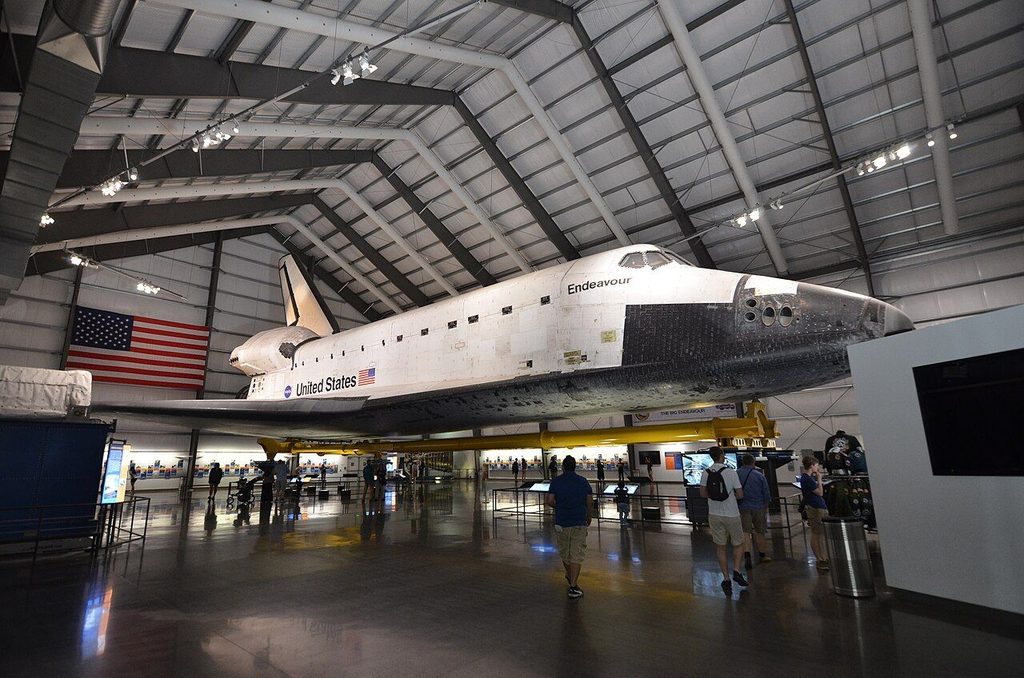
When it finally reached Exposition Park, Endeavour was placed in a temporary pavilion beside the main building, where it was shown horizontally, nose forward, raised on supports so visitors could walk underneath it.
Seeing the orbiter up close
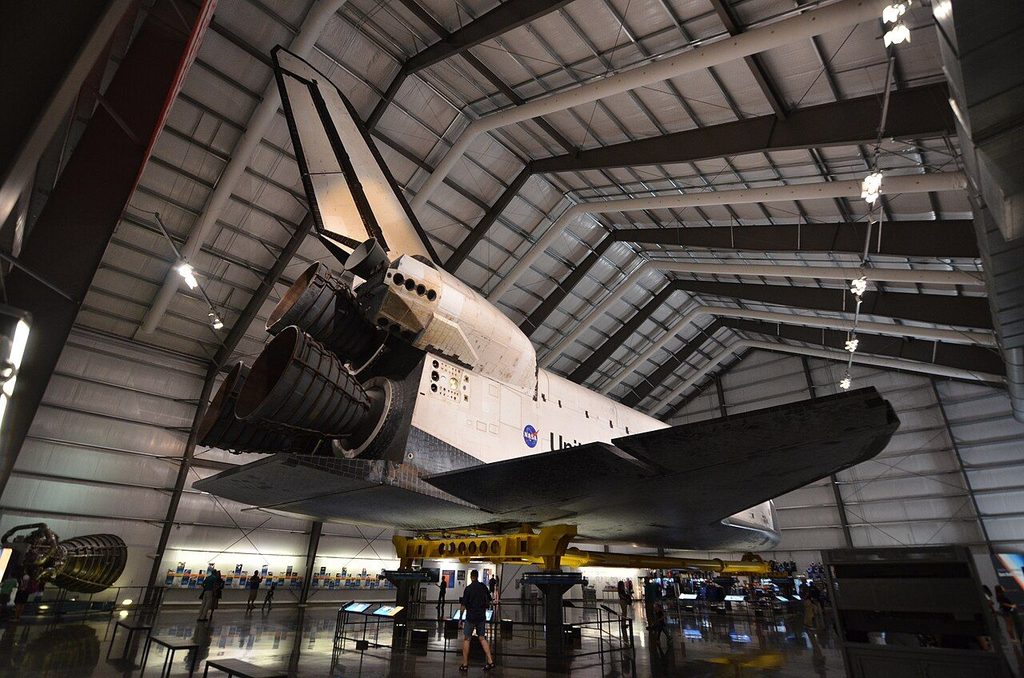
Standing under a shuttle is the experience that people talk about afterwards. The scale is the first surprise: the orbiter is about the length of a commercial airliner, with a wing that seems to fill the room. The second is the surface. The black and white heat-protection tiles are scuffed, patched and stained from re-entry, and you can see that each tile has its own shape and number. Close to the tail, the three main engine bells sit in a cluster, wide enough to stand in.
Look for the small details too. The windows of the flight deck sit high on the nose, the payload bay doors run most of the length of the body, and the black tiles on the underside are worn in streaks from the heat of each return through the atmosphere. Walking slowly around the whole orbiter, rather than stopping at the nose for a photograph, shows how much repair and care went into keeping it flying.
Displays around the orbiter have covered its missions, the crews who flew it and the people who built and repaired it between flights. Endeavour was built as a replacement after the loss of Challenger in 1986, and it went on to serve the Hubble Space Telescope and help assemble the International Space Station.
The upright display project
The horizontal pavilion was always meant to be temporary. The museum's long-term plan is to show Endeavour upright, in launch position, mated to a real external fuel tank and a pair of solid rocket boosters, inside a new air and space centre on the north side of the building. In recent years the boosters, the tank and the orbiter were lifted into place, and the new building has been rising around the stack.
While that work goes on, the shuttle may be partly or wholly off view, and the date when the new gallery opens has not been fixed in this guide. When it opens, the upright display should be one of the few places in the world where you can see a complete shuttle stack as it stood on the launch pad.
Next door: The Coliseum and two Olympic Games
The other galleries
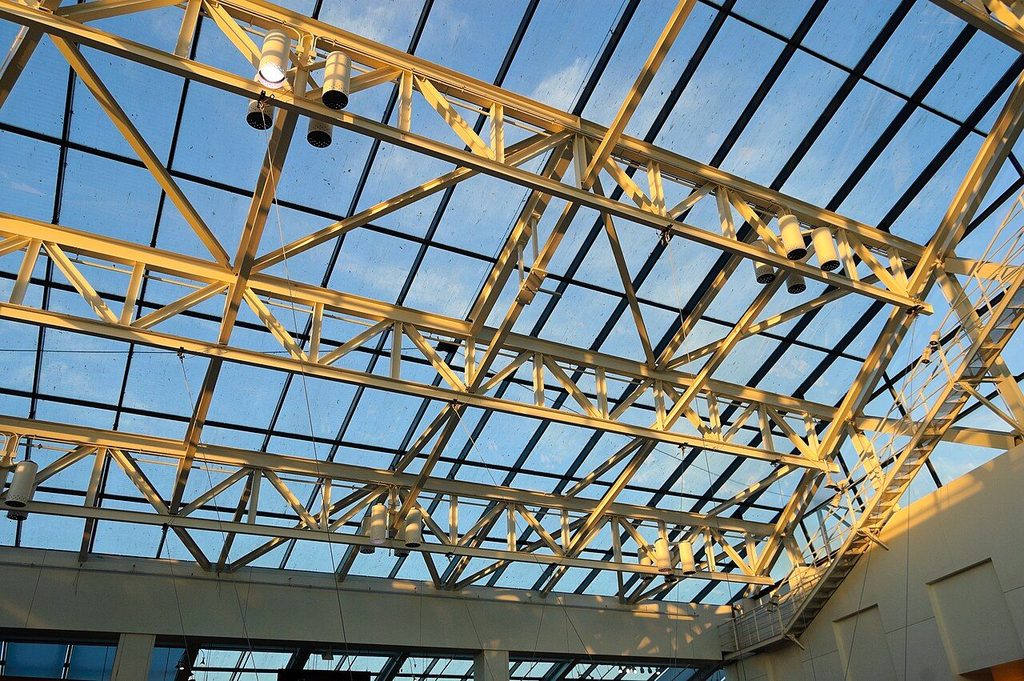
Most of the Science Center's permanent galleries sit in the main building, entered through a broad atrium with a glass roof. They are aimed at curious visitors of every age, though they are especially good for children who like to press buttons and try things.
- Ecosystems covers habitats from deserts to polar regions, with live animals and a large kelp forest tank where you walk through a tunnel under the fish.
- World of Life looks at how living things work, from single cells to the human body.
- Creative World deals with structures, transport and communication, with hands-on models.
- Air and space exhibits show aircraft and spacecraft, including capsules and satellites, before the shuttle itself.
Special exhibitions change through the year and often carry their own charge. There is also a large-format theatre showing science films, which needs a separate ticket. The building can be noisy on school days, so if you prefer quiet, aim for a weekday afternoon or the first hour after opening at the weekend.
Tickets and timed entry
For many years general admission to the Science Center's permanent galleries has been free, with charges for special exhibitions, the theatre and, at busy times, a small fee for a timed reservation to see Endeavour. Weekends and school holidays fill up first.
Bags may be checked at entry, and the building is fully accessible, with lifts between levels. Food is available inside, and the park outside has lawns and benches for a picnic break between galleries.
Getting there and nearby
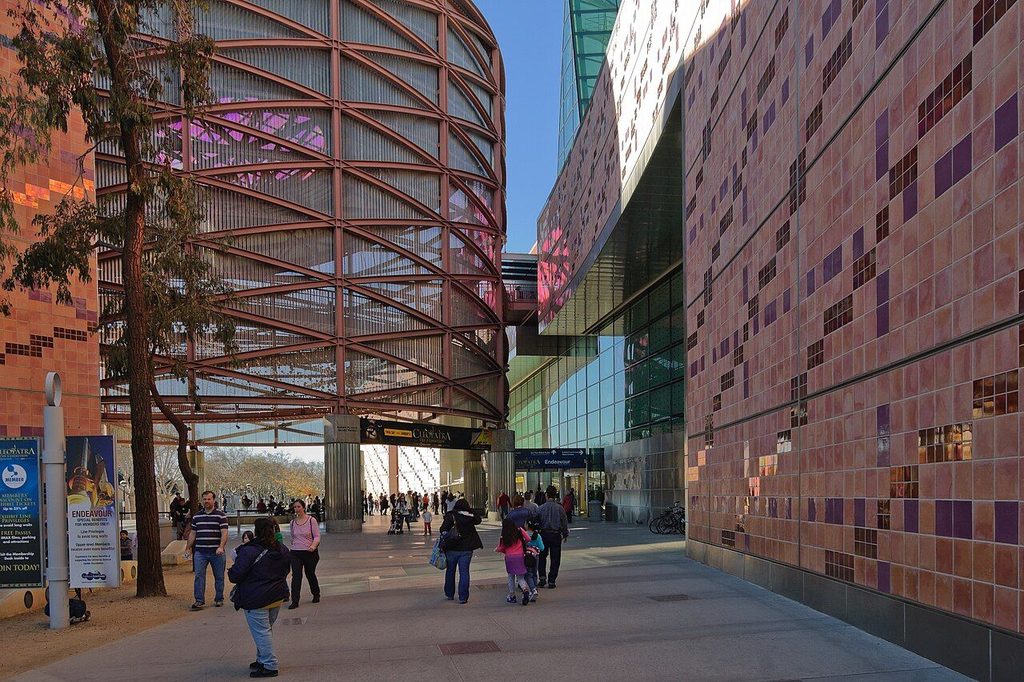
The Science Center stands in the middle of Exposition Park, a few minutes' walk from Expo Park/USC station on the E Line. Paid parking is available in the park structures, but on stadium event days traffic around the park slows to a crawl, and the train is the easier choice. The route from downtown takes only a few stops, and our guide to the E Line from Exposition Park to the sea covers the line in full.
Next door, the Natural History Museum holds the dinosaur hall and gardens described in our guide to the Natural History Museum, and the California African American Museum is on the same plaza. The great stadium on the park's east side is a reminder that this corner of the city has hosted two Olympic Games, with a third on the way.
Filed in Inside Exposition Park
Walk on: The Coliseum and two Olympic Games · back to Natural History Museum · all eight walks
Thanks for the photos: Steven Lek; license CC BY-SA; Steven Lek; license CC BY-SA; King of Hearts; license CC BY-SA; King of Hearts; license CC BY-SA


