Around University Park · walk 6 of 8 ·
Brick and arches on the USC campus
Across Exposition Boulevard from the park, the university campus is a district of red brick, round arches and tile roofs, best seen on a slow weekend walk.
- MetroExpo Park/USC, E Line
- Getting thereE Line to Expo Park/USC, cross Exposition
- BringWalking shoes, a hat, a campus map
The University of Southern California was founded in 1880, when this part of Los Angeles was still orchards and open land. The campus grew up just north of what became Exposition Park, and today the two face each other across Exposition Boulevard. For a visitor, the attraction is the architecture: a core of red-brick buildings in the Romanesque Revival style, built mostly between the 1920s and the 1930s, with round arches, tile roofs, towers and carved stone, arranged along shaded walks and small lawns.
The campus is a working university, not a museum, so walk with that in mind. Outdoor areas are generally open to the public, while most buildings are for students and staff. The quietest time to explore is a weekend morning outside exam and event periods.
A style chosen for a young city
In the early twentieth century the university's leaders wanted buildings that would look old and serious in a city that was young and changing fast. They chose a style based on the Romanesque churches and civic buildings of northern Italy: heavy brick walls, round-headed arches, arcades, bell towers and decorative stonework. The effect, repeated across many buildings, gives the older part of the campus a strong, unified look.
Look closely as you walk and the details repeat from building to building: brick laid in patterns around windows, carved stone capitals on short columns, arcades that give shade along the walls, and tile roofs with deep eaves. The style suits the climate, keeping interiors cool and throwing strong shadows across the walks at midday. Later buildings, from the mid-century onwards, mixed in concrete and glass, and some of those are good examples of their own decades. More recently, new buildings on the campus edges have returned to brick and arches, so that the newer quarters echo the original core.
Bovard and its tower
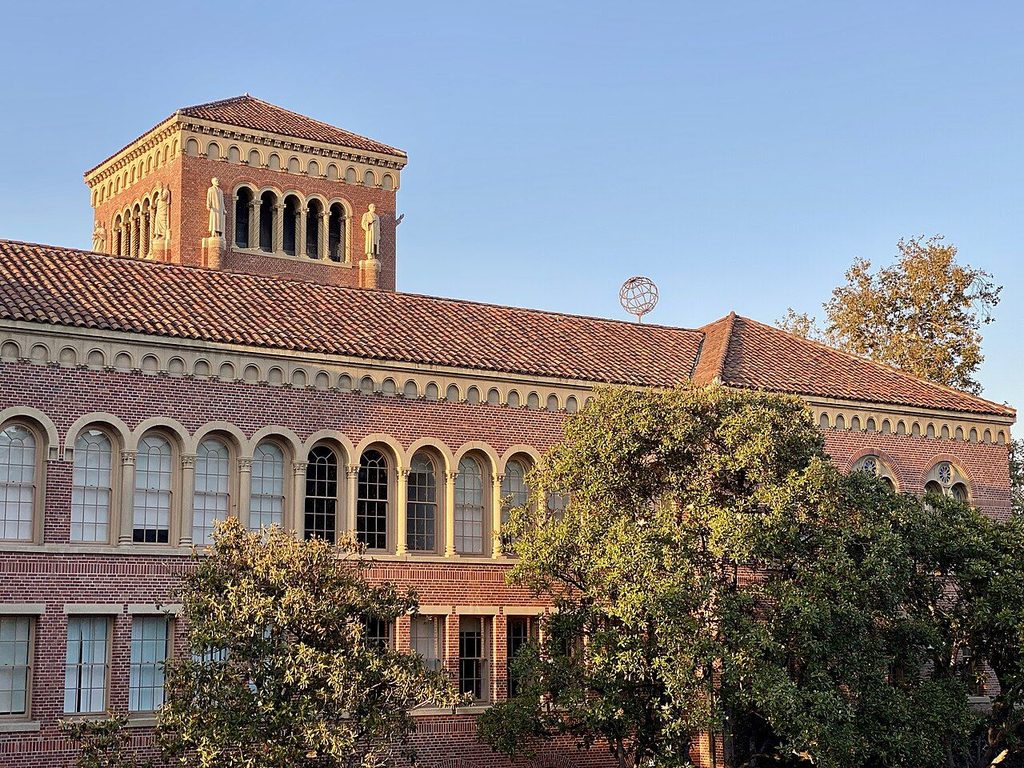
Bovard Administration Building, with its auditorium, is one of the oldest buildings in the Romanesque group, completed in the early 1920s. Its square brick tower, with an open arcade near the top and stone figures standing at its corners, is one of the campus landmarks, visible from many of the walks around it. The long front is lined with round-arched windows, and in the late afternoon the brick turns orange in the low sun.
The auditorium inside is used for concerts, lectures and university events, and it is open to the public only when something is on. The best views of the building are from the open walk in front of it, near the centre of campus.
Doheny Memorial Library
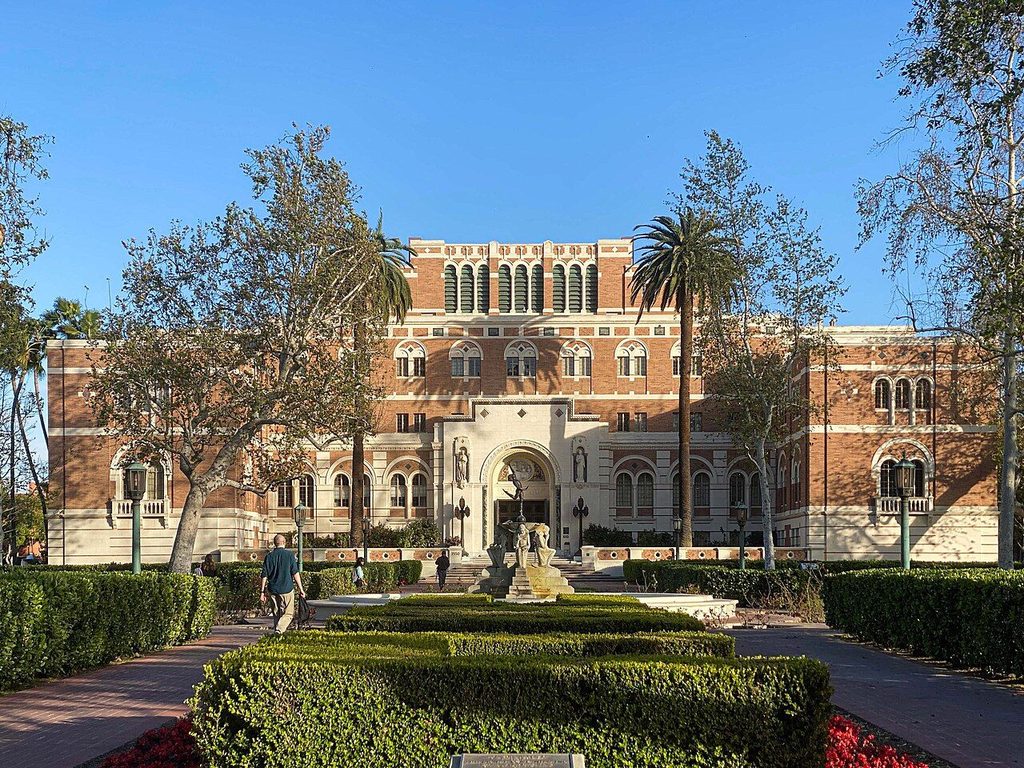
A short walk away stands the Doheny Memorial Library, opened in 1932. It was paid for by the Doheny family as a memorial to Edward L. Doheny Jr., who had died a few years before, and it is often considered the finest building on campus. The design draws on Italian Romanesque churches, with a symmetrical brick front, a deep entrance arch framed in carved stone, and rows of arched windows. Inside, the main reading rooms have painted ceilings, carved wood and stained glass.
Next door: Victorian houses of St. James Park and Chester Place
The library is a working building for the university, and access for visitors may be limited or need identification. From the outside, the best view is from the formal garden and fountain in front of the entrance, which line up with the main door. The same family built the great house at Chester Place, a mile or so to the north, which you can see on our walk through the Victorian houses of St. James Park and Chester Place.
The Trojan statue and the centre of campus
At the heart of the campus stands the bronze statue of a Trojan warrior, raised on a stone base in 1930 and known on campus as Tommy Trojan. It is the traditional meeting place and the most photographed spot on the grounds. Around it, the main walks lead to the older halls, and you can see how the campus planners used long axes, lawns and fountains to tie the brick buildings together.
Before big football games, the statue is often wrapped up to protect it from rival fans, a long-standing campus tradition. On those weekends the whole area is busy, with crowds walking south to the Los Angeles Memorial Coliseum, where the university's football team plays its home games.
A quiet weekend walk
A simple loop takes about an hour. Start from Expo Park/USC station and cross Exposition Boulevard into campus. Walk north along the main walk towards the centre, stopping at the Trojan statue. From there, find Bovard and its tower, then head west to the Doheny Memorial Library and its fountain. Wander through the arcades and courtyards of the nearby halls, where much of the best brick and stone detail is found at eye level, then return south towards the park.
- Stay on paths and out of classrooms, labs and offices.
- Avoid move-in days, graduation weeks and home game days if you want quiet.
- Campus rules on access and photography can change; follow posted signs.
Getting there
Expo Park/USC station on the E Line sits right on the southern edge of campus, and there are other stops on the line and on the busway along the freeway to the east. Parking on campus is limited and paid. Combine your walk with a visit to the park across the street, where the rose garden is a short stroll from the station, and you have a full day without needing a car.
Filed in Around University Park
Walk on: Victorian houses of St. James Park and Chester Place · back to California African American Museum · all eight walks
Thanks for the photos: EEJCC; license CC BY-SA; EEJCC; license CC0

